How my Obsidian vault is put together - PARA folders, device sync through Nextcloud, manual git backups to Forgejo, and a separate content repo that publishes itself to prohomelab.com. Plus the rules I picked up from broken builds and the plan for getting everything back when the cluster dies.
Why self-hosted GitHub Actions on a single repository (article 3) turned out not to be the choice worth keeping - and how I reverted back to the proven two-repository Forgejo setup, walking through an honest comparison of both options along the way.
How I moved the build and deploy of ProHomelab from a homemade Forgejo runner to a self-hosted GitHub Actions runner on my own LXC, merged content and site into a single repository - and what didn’t go according to plan.
Migrating ProHomeLab from its old shared host to GitHub Pages on top of an already configured Obsidian → Forgejo → Hugo pipeline, while preserving all URLs and search engine rankings.
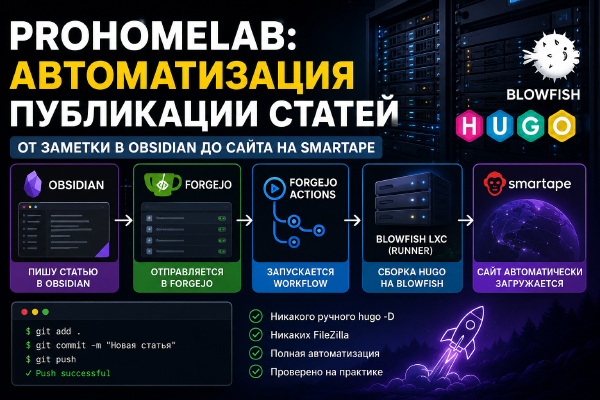
Fully automating ProHomeLab publishing: I write an article in Obsidian, the changes automatically land in Forgejo, Forgejo Actions triggers a Hugo build on a Blowfish LXC, and the finished site gets uploaded with no manual steps at all.
Deploying Hugo Extended and the Blowfish theme from a blank slate: from preparing an LXC and installing Hugo, to creating the site, connecting the theme, setting up the content structure, and the first production build.