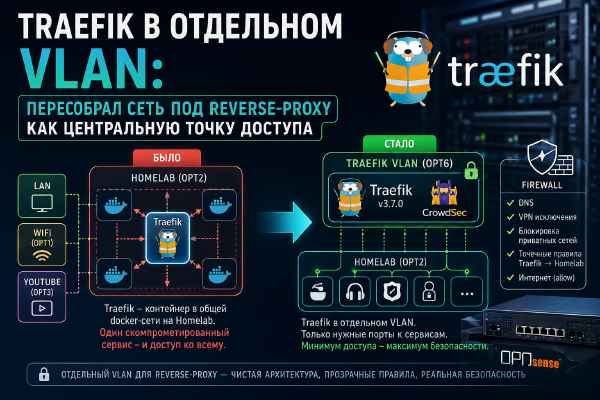
I’m moving Traefik to a dedicated VLAN and restructuring my homelab network architecture: the reverse proxy becomes the central access point to services, while OPNsense controls network access between VLANs.
Part three of the Traefik-in-LXC series - installing CrowdSec in the same container as Traefik itself. Scenario collections, a remediation profile with Gotify notifications, log sources (Traefik, syslog, AppSec), and wiring the bouncer plugin back into Traefik.
Middleware is the second most important building block of Traefik after routers. In this article I break down what it is, why it’s needed, how it’s applied, what a chain is, and I go through all the middlewares from the open-source version of Traefik with the configuration examples I use myself.
Continuing the series about Traefik in LXC - from a test binary to a working configuration. Cloudflare token, final static config, wildcard certificate, dashboard protection via Basic Auth, log rotation, dynamic config structure, and migrating a dozen services from Docker labels to the file provider. CrowdSec is planned as a separate follow-up.
A detailed guide to installing and configuring Traefik in an LXC container to set up a reverse proxy. Covers Docker setup, routing configuration, SSL integration, and recommendations for managing web traffic.
NetBird turns your devices into one private mesh network and, more recently, doubles as a reverse proxy - so home services go public without a single open port on the router.
Pangolin lets you publish local services to the internet without opening ports, using secure tunnels and a convenient web interface - an ideal solution for a home server and homelab.