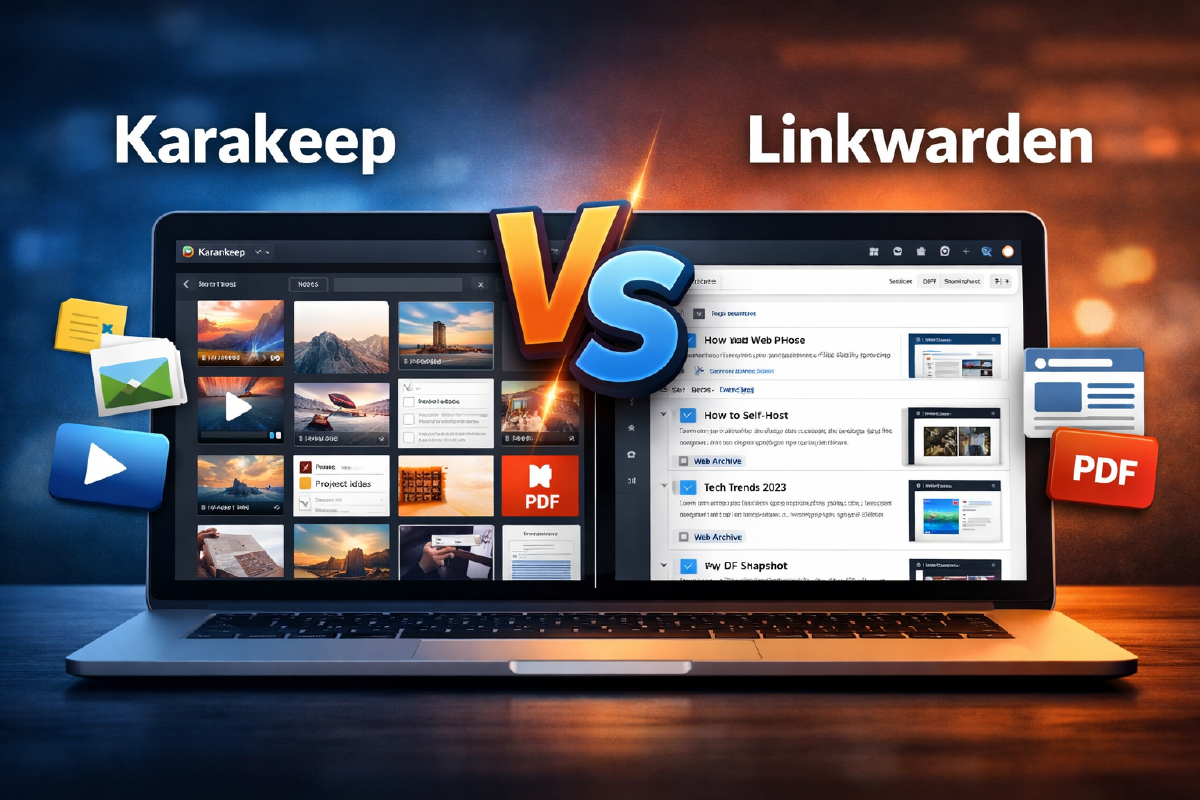

Karakeep vs Linkwarden: comparing self-hosted bookmark and link archive managers#
Introduction#
Self-hosted bookmark managers are an important part of a modern homelab and personal knowledge infrastructure. They let you not just save links, but archive content, protecting it from disappearing, blocking, and changes to the original sites.
In this article we’ll take a detailed look at Karakeep and Linkwarden - two popular open-source solutions for self-hosting. The material is aimed at:
- homelab owners;
- DevOps and system administrators;
- technical writers and researchers;
- users who want control over their data.
By the end of the article you’ll have a clear idea of which tool to choose for your particular scenario.
Brief overview of the projects#
Karakeep - a universal knowledge store#
Karakeep is a universal knowledge store. It combines:
- bookmarks;
- notes;
- images;
- PDF files;
- video;
- web page archives.
The project emphasizes search, indexing, and categorization of large volumes of data. Karakeep is often seen as a hybrid of a bookmark manager, a personal knowledge base, and a media archive.
Linkwarden#
Linkwarden is primarily a bookmark manager with powerful page archiving. For a full install and setup walkthrough, see the dedicated article linked above. Its core idea is to save a link so that it stays accessible even if the original site disappears.
Main focus:
- accurate web page preservation;
- convenient reading (reader view);
- long-term link archive;
- shared use of collections.
Karakeep vs Linkwarden comparison table#
| Criterion | Karakeep | Linkwarden |
|---|---|---|
| Solution type | Universal knowledge store | Bookmark manager with archiving |
| Main focus | Search, notes, media, AI | Bookmarks and web page saving |
| Self‑host | Yes | Yes |
| License | AGPL‑3.0 | AGPL‑3.0 |
| Data storage | File storage + built-in services | PostgreSQL + object storage |
| Page archiving | Yes | Yes (key feature) |
| PDF / images | Yes | Yes |
| Video | Yes | Limited |
| Reader‑view | Basic | Advanced |
| Full-text search | Yes (Meilisearch) | Yes (Meilisearch) |
| AI tags and analysis | Yes (OpenAI / Ollama) | Yes (Ollama) |
| Collaboration | Limited | Yes |
| Shared collections | No / limited | Yes |
| Browser extension | Yes | Yes |
| Mobile apps | Yes | Yes |
| Deployment complexity | Low | Medium |
| Suitable for homelab | Excellent | Good |
Functional differences#
Working with data#
Karakeep stores not just links, but full content:
- uploaded files;
- images;
- PDFs;
- video;
- notes.
This makes it convenient for building a personal knowledge base or “digital archive.”
Linkwarden, on the other hand, concentrates on links and web pages. It excels at preserving a page’s appearance, structure, and content, but doesn’t aim to be a universal store for everything.
Search and indexing#
Karakeep places a strong emphasis on search:
- full-text indexing;
- fast search through file contents;
- tags, categories, filters;
- AI automation (summaries, tags, content analysis).
Linkwarden also supports search, but it’s more oriented toward:
- page titles;
- URLs;
- tags;
- text of saved pages.
AI capabilities#
Karakeep can use local or cloud LLMs for:
- automatic tagging;
- content analysis;
- improved search.
This is especially useful if you have a large library of links and documents.
Linkwarden deliberately remains a more classic tool without AI logic.
Technical side and operations#
Deployment#
Karakeep:
- simpler to install;
- doesn’t require PostgreSQL;
- suits Docker, Podman, Kubernetes;
- feels good in a homelab and LXC containers.
Linkwarden:
- requires PostgreSQL;
- infrastructure is more complex;
- better suited to a permanent server with database backups.
Performance and resources#
Karakeep is generally lighter on resources and starts faster, especially in a minimal configuration.
Linkwarden can consume more resources due to:
- the database;
- generating page archives;
- screenshots and PDFs.
User experience#
Karakeep:
- oriented toward search and navigation;
- suited for large collections;
- the interface is less “read-it-later,” but more universal.
Linkwarden:
- convenient for reading;
- strong reader view;
- logical for everyday work with bookmarks and articles.
What to choose and in which scenarios#
Choose Karakeep if:#
- you need a unified archive (bookmarks + files + notes);
- fast search across all content matters to you;
- you’re interested in AI capabilities;
- you’re building a personal knowledge base or homelab storage.
Choose Linkwarden if:#
- your main task is bookmarks and articles;
- quality page archiving matters;
- you need a reader view and reading mode;
- you’re planning collaboration or shared collections.
Summary and recommendations#
Karakeep and Linkwarden solve a similar problem - saving and managing links - but with different philosophies.
Karakeep is a universal knowledge hub that combines bookmarks, files, notes, and search in one interface. It’s especially well suited for homelab, personal knowledge bases, and users who value flexibility and scalability.
Linkwarden is a specialized tool for archiving web pages and articles. It’s excellent for read-it-later scenarios, research work, and shared use of collections.
Quick pick#
- For homelab, personal archiving, and experimenting with AI - Karakeep.
- For neatly storing articles and links with an emphasis on reading - Linkwarden.
Both projects are actively developed and deserve attention. The optimal choice doesn’t come down to “better or worse,” but rather to how exactly you work with information.